American Politics: Theory & Practice---Part I
Explore American politics with this essential reading list featuring Jeffrey Toobin's *The Nine*, Robert Caro's *Master of the Senate*, and de Tocqueville's *Democracy in America*.



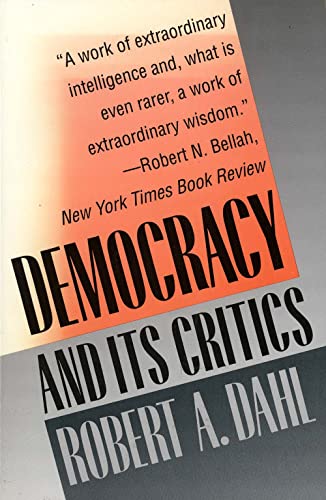
Book
Democracy in America
by Alexis de Tocqueville
Alexis de Tocqueville (1805-59) came to America in 1831 to see what a great republic was like. What struck him most was the country's equality of conditions, its democracy. The book he wrote on his return to France, Democracy in America, is both the best ever written on democracy and the best ever written on America. It remains the most often quoted book about the United States, not only because it has something to interest and please everyone, but also because it has something to teach everyone. When it was published in 2000, Harvey Mansfield and Delba Winthrop's new translation of Democracy in America—only the third since the original two-volume work was published in 1835 and 1840—was lauded in all quarters as the finest and most definitive edition of Tocqueville's classic thus far. Mansfield and Winthrop have restored the nuances of Tocqueville's language, with the expressed goal "to convey Tocqueville's thought as he held it rather than to restate it in comparable terms of today." The result is a translation with minimal interpretation, but with impeccable annotations of unfamiliar references and a masterful introduction placing the work and its author in the broader contexts of political philosophy and statesmanship.




Book
Master of the Senate
by Robert A. Caro
Master of the Senate, Book Three of The Years of Lyndon Johnson, carries Johnson’s story through one of its most remarkable periods: his twelve years, from 1949 to 1960, in the United States Senate. At the heart of the book is its unprecedented revelation of how legislative power works in America, how the Senate works, and how Johnson, in his ascent to the presidency, mastered the Senate as no political leader before him had ever done. It was during these years that all Johnson’s experience—from his Texas Hill Country boyhood to his passionate representation in Congress of his hardscrabble constituents to his tireless construction of a political machine—came to fruition. Caro introduces the story with a dramatic account of the Senate itself: how Daniel Webster, Henry Clay, and John C. Calhoun had made it the center of governmental energy, the forum in which the great issues of the country were thrashed out. And how, by the time Johnson arrived, it had dwindled into a body that merely responded to executive initiatives, all but impervious to the forces of change. Caro anatomizes the genius for political strategy and tactics by which, in an institution that had made the seniority system all-powerful for a century and more, Johnson became Majority Leader after only a single term-the youngest and greatest Senate Leader in our history; how he manipulated the Senate’s hallowed rules and customs and the weaknesses and strengths of his colleagues to change the “unchangeable” Senate from a loose confederation of sovereign senators to a whirring legislative machine under his own iron-fisted control. Caro demonstrates how Johnson’s political genius enabled him to reconcile the unreconcilable: to retain the support of the southerners who controlled the Senate while earning the trust—or at least the cooperation—of the liberals, led by Paul Douglas and Hubert Humphrey, without whom he could not achieve his goal of winning the presidency. He shows the dark side of Johnson’s ambition: how he proved his loyalty to the great oil barons who had financed his rise to power by ruthlessly destroying the career of the New Dealer who was in charge of regulating them, Federal Power Commission Chairman Leland Olds. And we watch him achieve the impossible: convincing southerners that although he was firmly in their camp as the anointed successor to their leader, Richard Russell, it was essential that they allow him to make some progress toward civil rights. In a breathtaking tour de force, Caro details Johnson’s amazing triumph in maneuvering to passage the first civil rights legislation since 1875. Master of the Senate, told with an abundance of rich detail that could only have come from Caro’s peerless research, is both a galvanizing portrait of the man himself—the titan of Capital Hill, volcanic, mesmerizing—and a definitive and revelatory study of the workings and personal and legislative power.

Book
The Nine
by Jeffrey Toobin
Drawing on exclusive interviews with the Supreme Court justices and other insiders, a behind-the-scenes look at the powerful, often secretive world of the Supreme Court offers profiles of each justice and how their individual styles affect the way in which they wield their power and discusses how the Court operates, the recent appointments of John Roberts and Samuel Alito, and the Court's influence on American life. 150,000 first printing.