Historical Nonfiction that Connects with Genealogy
Explore the best historical nonfiction books that connect with genealogy. Discover how Mayflower, A Midwife's Tale, and Born Fighting bring your family history to life through compelling American stories.

Book
Generations
by Neil Howe
Hailed by national leaders as politically diverse as former Vice President Al Gore and former House Speaker Newt Gingrich, Generations has been heralded by reviewers as a brilliant, if somewhat unsettling, reassessment of where America is heading. William Strauss and Neil Howe posit the history of America as a succession of generational biographies, beginning in 1584 and encompassing every-one through the children of today. Their bold theory is that each generation belongs to one of four types, and that these types repeat sequentially in a fixed pattern. The vision of Generations allows us to plot a recurring cycle in American history -- a cycle of spiritual awakenings and secular crises -- from the founding colonists through the present day and well into this millenium. Generations is at once a refreshing historical narrative and a thrilling intuitive leap that reorders not only our history books but also our expectations for the twenty-first century.

Book
Mayflower
by Nathaniel Philbrick
A history of the Pilgrim settlement of New England discusses such topics as the diseases of European origin suffered by the Wampanoag tribe, the relationship between the Pilgrims and their Native American neighbors, and the impact of King Philip's War.

Book
The Unredeemed Captive
by John Demos
Nominated for the National Book Award and winner of the Francis Parkman Prize. The setting for this haunting and encyclopedically researched work of history is colonial Massachusetts, where English Puritans first endeavoured to "civilize" a "savage" native populace. There, in February 1704, a French and Indian war party descended on the village of Deerfield, abducting a Puritan minister and his children. Although John Williams was eventually released, his daughter horrified the family by staying with her captors and marrying a Mohawk husband. Out of this incident, The Bancroft Prize-winning historian John Devos has constructed a gripping narrative that opens a window into North America where English, French, and Native Americans faced one another across gilfs of culture and belief, and sometimes crossed over.

Book
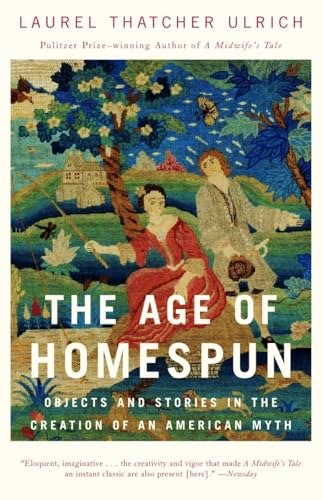
A Midwife's Tale
by Laurel Thatcher Ulrich
PULITZER PRIZE WINNER • Drawing on the diaries of one woman in eighteenth-century Maine, "A truly talented historian unravels the fascinating life of a community that is so foreign, and yet so similar to our own" (The New York Times Book Review). Between 1785 and 1812 a midwife and healer named Martha Ballard kept a diary that recorded her arduous work (in 27 years she attended 816 births) as well as her domestic life in Hallowell, Maine. On the basis of that diary, Laurel Thatcher Ulrich gives us an intimate and densely imagined portrait, not only of the industrious and reticent Martha Ballard but of her society. At once lively and impeccably scholarly, A Midwife's Tale is a triumph of history on a human scale.

Book
Born Fighting
by Jim Webb
More than 27 million Americans today can trace their lineage to the Scots, whose bloodline was stained by centuries of continuous warfare along the border between England and Scotland, and later in the bitter settlements of England’s Ulster Plantation in Northern Ireland. Between 250,000 and 400,000 Scots-Irish migrated to America in the eighteenth century, traveling in groups of families and bringing with them not only long experience as rebels and outcasts but also unparalleled skills as frontiersmen and guerrilla fighters. Their cultural identity reflected acute individualism, dislike of aristocracy and a military tradition, and, over time, the Scots-Irish defined the attitudes and values of the military, of working class America, and even of the peculiarly populist form of American democracy itself. Born Fighting is the first book to chronicle the full journey of this remarkable cultural group, and the profound, but unrecognized, role it has played in the shaping of America. Written with the storytelling verve that has earned his works such acclaim as “captivating . . . unforgettable” (the Wall Street Journal on Lost Soliders), Scots-Irishman James Webb, Vietnam combat veteran and former Naval Secretary, traces the history of his people, beginning nearly two thousand years ago at Hadrian’s Wall, when the nation of Scotland was formed north of the Wall through armed conflict in contrast to England’s formation to the south through commerce and trade. Webb recounts the Scots’ odyssey—their clashes with the English in Scotland and then in Ulster, their retreat from one war-ravaged land to another. Through engrossing chronicles of the challenges the Scots-Irish faced, Webb vividly portrays how they developed the qualities that helped settle the American frontier and define the American character. Born Fighting shows that the Scots-Irish were 40 percent of the Revolutionary War army; they included the pioneers Daniel Boone, Lewis and Clark, Davy Crockett, and Sam Houston; they were the writers Edgar Allan Poe and Mark Twain; and they have given America numerous great military leaders, including Stonewall Jackson, Ulysses S. Grant, Audie Murphy, and George S. Patton, as well as most of the soldiers of the Confederacy (only 5 percent of whom owned slaves, and who fought against what they viewed as an invading army). It illustrates how the Scots-Irish redefined American politics, creating the populist movement and giving the country a dozen presidents, including Andrew Jackson, Teddy Roosevelt, Woodrow Wilson, Ronald Reagan, and Bill Clinton. And it explores how the Scots-Irish culture of isolation, hard luck, stubbornness, and mistrust of the nation’s elite formed and still dominates blue-collar America, the military services, the Bible Belt, and country music. Both a distinguished work of cultural history and a human drama that speaks straight to the heart of contemporary America, Born Fighting reintroduces America to its most powerful, patriotic, and individualistic cultural group—one too often ignored or taken for granted.