History of Ideas and Ideas in History 1
Explore the history of ideas through six transformative books, from Kuhn’s scientific revolutions to Camus’ absurdism and Pagels’ gnostic gospels.

Book
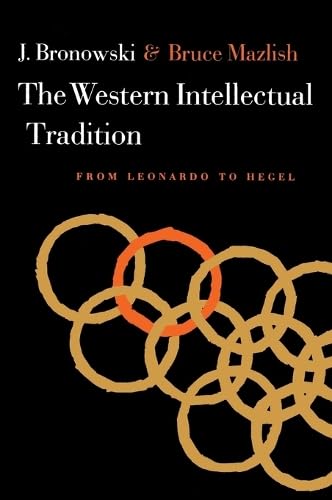
Western Intellectual Tradition: From Leonardo to Hegel
by Jacob Bronowski
No summary available.

Book
The Structure of Scientific Revolutions
by Thomas S. Kuhn
Thomas S. Kuhn's classic book is now available with a new index.

Book
The Myth of Sisyphus, and Other Essays
by Albert Camus
One of the most influential works of this century, The Myth of Sisyphus and Other Essays is a crucial exposition of existentialist thought. Influenced by works such as Don Juan and the novels of Kafka, these essays begin with a meditation on suicide; the question of living or not living in a universe devoid of order or meaning. With lyric eloquence, Albert Camus brilliantly posits a way out of despair, reaffirming the value of personal existence, and the possibility of life lived with dignity and authenticity.



Book
The Discoverers
by Daniel J. Boorstin
An original history of man's greatest adventure: his search to discover the world around him. In the compendious history, Boorstin not only traces man's insatiable need to know, but also the obstacles to discovery and the illusion that knowledge can also put in our way. Covering time, the earth and the seas, nature and society, he gathers and analyzes stories of the man's profound quest to understand his world and the cosmos.



Book
The Gnostic Gospels
by Elaine Pagels
NATIONAL BESTSELLER • NATIONAL BOOK AWARD WINNER • NATIONAL BOOK CRITICS CIRCLE WINNER • SELECTED BY THE MODERN LIBRARY AS ONE OF THE 100 BEST NONFICTION BOOKS • The landmark study exploring alternative perspectives of early Christianity as revealed through the Nag Hammadi texts that could have shaped the religion differently if included in the Christian canon • "[Pagels] is always readable, always deeply informed, always richly suggestive of pathways her readers may wish to follow out for themselves."—Harold Bloom, The Washington Post “[Pagels] writes with the instincts of a novelist, the skill of a scholar, and the ability to sort out significances that many writers lack.”—Chicago Tribune • “An intellectually elegant, concise study . . . The economy with which [Pagels] evokes the world of early Christianity is a marvel.”—The New Yorker The Gnostic Gospels is a work of luminous scholarship and wide popular appeal. First published in 1979 to critical acclaim, winning the National Book Award and the National Book Critics Circle Award, The Gnostic Gospels has continued to grow in reputation and influence. It is now widely recognized as one of the most brilliant and accessible histories of early Christian spirituality published in our time. In 1945 an Egyptian peasant unearthed what proved to be the Gnostic Gospels, thirteen papyrus volumes that expounded a radically different view of the life and teachings of Jesus Christ from that of the New Testament. In this spellbinding book, renowned religious scholar Elaine Pagels elucidates the mysteries and meanings of these sacred texts both in the world of the first Christians and in the context of Christianity today. With insight and passion, Pagels explores a remarkable range of recently discovered gospels, including the Gospel of Thomas and the Gospel of Mary Magdalene, to show how a variety of “Christianities” emerged at a time of extraordinary spiritual upheaval. Some Christians questioned the need for clergy and church doctrine, and taught that the divine could be discovered through spiritual search. Many others, like Buddhists and Hindus, sought enlightenment—and access to God—within. Such explorations raised questions: Was the resurrection to be understood symbolically and not literally? Was God to be envisioned only in masculine form, or feminine as well? Was martyrdom a necessary—or worthy—expression of faith? These early Christians dared to ask questions that orthodox Christians later suppressed—and their explorations led to profoundly different visions of Jesus and his message. Brilliant and stunning in its implications, The Gnostic Gospels is a radical, eloquent reconsideration of the origins of the Christian faith.


Book
Seven Types of Ambiguity
by Elliot Perlman
Seven Types of Ambiguity is a psychological thriller and a literary adventure of breathtaking scope. Celebrated as a novelist in the tradition of Jonathan Franzen and Philip Roth, Elliot Perlman writes of impulse and paralysis, empty marriages, lovers, gambling, and the stock market; of adult children and their parents; of poetry and prostitution, psychiatry and the law. Comic, poetic, and full of satiric insight, Seven Types of Ambiguity is, above all, a deeply romantic novel that speaks with unforgettable force about the redemptive power of love. The story is told in seven parts, by six different narrators, whose lives are entangled in unexpected ways. Following years of unrequited love, an out-of-work schoolteacher decides to take matters into his own hands, triggering a chain of events that neither he nor his psychiatrist could have anticipated. Brimming with emotional, intellectual, and moral dilemmas, this novel-reminiscent of the richest fiction of the nineteenth century in its labyrinthine complexity-unfolds at a rapid-fire pace to reveal the full extent to which these people have been affected by one another and by the insecure and uncertain times in which they live. Our times, now.

Book
The Rhetoric of Fiction
by Wayne C. Booth
A standard reference point in advanced discussions of how fictional form works, how authors make novels accessible, and how readers recreate texts. Its concepts and terms have become standard critical lexicon.