know for sure that life is pointless?
Explore the philosophy of nihilism and absurdism with essential books by Nietzsche, Camus, Sartre, and Kafka—find meaning in a meaningless world.

Book
Existentialism and Human Emotions
by Jean-Paul Sartre
Proposes that individuals must create their own values, take responsibility for their actions, and find a sense of meaning while living in a universe without purpose.

Book
The Myth of Sisyphus, and Other Essays
by Albert Camus
One of the most influential works of this century, The Myth of Sisyphus and Other Essays is a crucial exposition of existentialist thought. Influenced by works such as Don Juan and the novels of Kafka, these essays begin with a meditation on suicide; the question of living or not living in a universe devoid of order or meaning. With lyric eloquence, Albert Camus brilliantly posits a way out of despair, reaffirming the value of personal existence, and the possibility of life lived with dignity and authenticity.

Book
The Stranger
by Albert Camus
With the intrigue of a psychological thriller, The Stranger—Camus's masterpiece—gives us the story of an ordinary man unwittingly drawn into a senseless murder on an Algerian beach. With an Introduction by Peter Dunwoodie; translated by Matthew Ward. Behind the subterfuge, Camus explores what he termed "the nakedness of man faced with the absurd" and describes the condition of reckless alienation and spiritual exhaustion that characterized so much of twentieth-century life. “The Stranger is a strikingly modern text and Matthew Ward’s translation will enable readers to appreciate why Camus’s stoical anti-hero and devious narrator remains one of the key expressions of a postwar Western malaise, and one of the cleverest exponents of a literature of ambiguity.” –from the Introduction by Peter Dunwoodie First published in 1946; now in translation by Matthew Ward.


Book
The Metamorphosis
by Franz Kafka
“When Gregor Samsa woke up one morning from unsettling dreams, he found himself changed in his bed into a monstrous vermin.” With this startling, bizarre, yet surprisingly funny first sentence, Kafka begins his masterpiece, The Metamorphosis. It is the story of a young man who, transformed overnight into a giant beetlelike insect, becomes an object of disgrace to his family, an outsider in his own home, a quintessentially alienated man. A harrowing—though absurdly comic—meditation on human feelings of inadequacy, guilt, and isolation, The Metamorphosis has taken its place as one of the most widely read and influential works of twentieth-century fiction. As W.H. Auden wrote, “Kafka is important to us because his predicament is the predicament of modern man.”
Book
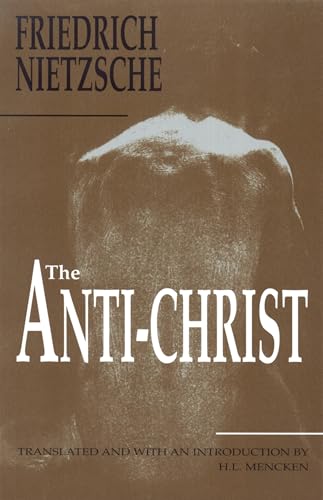
The Anti-Christ
by Friedrich Wilhelm Nietzsche
This is Nietzsche's last book and a fitting capstone to his career. It's succinct, biting, and encapsulates the criticisms of Christianity found in his other works. This edition contains an 8,000-word introduction by its translator, the famous iconoclastic writer H. L. Mencken.