The Best Books Ive read
Discover the best books I've read, from Kurt Vonnegut's sci-fi classics and Catch-22 to Don Quixote and On the Road—a curated list of unforgettable fiction.

Book
Don Quixote
by Miguel De Cervantes Saavedra
Nominated as one of America’s best-loved novels by PBS’s The Great American Read Don Quixote has become so entranced reading tales of chivalry that he decides to turn knight errant himself. In the company of his faithful squire, Sancho Panza, these exploits blossom in all sorts of wonderful ways. While Quixote's fancy often leads him astray—he tilts at windmills, imagining them to be giants—Sancho acquires cunning and a certain sagacity. Sane madman and wise fool, they roam the world together-and together they have haunted readers' imaginations for nearly four hundred years. With its experimental form and literary playfulness, Don Quixote has been generally recognized as the first modern novel. This Penguin Classics edition, with its beautiful new cover design, includes John Rutherford's masterly translation, which does full justice to the energy and wit of Cervantes's prose, as well as a brilliant critical introduction by Roberto Gonzalez Echevarriá.

Book
Bluebeard
by Kurt Vonnegut
“Ranks with Vonnegut’s best and goes one step beyond . . . joyous, soaring fiction.”—The Atlanta Journal and Constitution Broad humor and bitter irony collide in this fictional autobiography of Rabo Karabekian, who, at age seventy-one, wants to be left alone on his Long Island estate with the secret he has locked inside his potato barn. But then a voluptuous young widow badgers Rabo into telling his life story—and Vonnegut in turn tells us the plain, heart-hammering truth about man’s careless fancy to create or destroy what he loves. Praise for Bluebeard “Vonnegut is at his edifying best.”—The Philadelphia Inquirer “The quicksilver mind of Vonnegut is at it again. . . . He displays all his talents—satire, irony, ridicule, slapstick, and even a shaggy dog story of epic proportions.”—The Cincinnati Post “[Kurt Vonnegut is] a voice you can trust to keep poking holes in the social fabric.”—San Francisco Chronicle “It has the qualities of classic Bosch and Slaughterhouse Vonnegut. . . . Bluebeard is uncommonly feisty.”—USA Today “Is Bluebeard good? Yes! . . . This is vintage Vonnegut—good wine from his best grapes.”—The Detroit News “A joyride . . . Vonnegut is more fascinated and puzzled than angered by the human stupidities and contradictions he discerns so keenly. So hop in his rumble seat. As you whiz along, what you observe may provide some new perspectives.”—Kansas City Star

Book
Catch-22
by Joseph Heller
Catch-22 is like no other novel. It is one of the funniest books ever written, a keystone work in American literature, and even added a new term to the dictionary. At the heart of Catch-22 resides the incomparable, malingering bombardier, Yossarian, a hero endlessly inventive in his schemes to save his skin from the horrible chances of war. His efforts are perfectly understandable because as he furiously scrambles, thousands of people he hasn't even met are trying to kill him. His problem is Colonel Cathcart, who keeps raising the number of missions the men must fly to complete their service. Yet if Yossarian makes any attempts to excuse himself from the perilous missions that he is committed to flying, he is trapped by the Great Loyalty Oath Crusade, the hilariously sinister bureaucratic rule from which the book takes its title: a man is considered insane if he willingly continues to fly dangerous combat missions, but if he makes the necessary formal request to be relieved of such missions, the very act of making the request proves that he is sane and therefore ineligible to be relieved. Catch-22 is a microcosm of the twentieth-century world as it might look to some one dangerously sane -- a masterpiece of our time.


Book
Do Androids Dream of Electric Sheep?
by Philip K. Dick
World War Terminus had left the Earth devastated. Through its ruins, bounty hunter Rick Deckard stalked, in search of the renegade replicants who were his prey. When he wasn¿t ¿retiring¿ them with his laser weapon, he dreamed of owning a live animal -- the ultimate status symbol in a world all but bereft of animal life. Then Rick got his chance: the assignment to kill six Nexus-6 targets, for a huge reward. But in Deckard¿s world things were never that simple, and his assignment quickly turned into a nightmare kaleidoscope of subterfuge and deceit -- and the threat of death for the hunter rather than the hunted...

Book
On the Road
by Jack Kerouac
Jack Kerouac’s classic American novel of freedom and the search for originality that defined a generation “An authentic work of art.”—The New York Times Inspired by Jack Kerouac’s adventures with Neal Cassady, On the Road tells the story of two friends whose cross-country road trips are a quest for meaning and true experience. Written with a mixture of sad-eyed naïveté and wild abandon and imbued with Kerouac’s love of America, his compassion for humanity, and his sense of language as jazz, On the Road is the quintessential American vision of freedom and hope—a book that changed American literature and changed anyone who has ever picked it up.

Book
The Catcher in the Rye
by J.D. Salinger
The "brilliant, funny, meaningful novel" (The New Yorker) that established J. D. Salinger as a leading voice in American literature--and that has instilled in millions of readers around the world a lifelong love of books. "If you really want to hear about it, the first thing you'll probably want to know is where I was born, and what my lousy childhood was like, and how my parents were occupied and all before they had me, and all that David Copperfield kind of crap, but I don't feel like going into it, if you want to know the truth." The hero-narrator of The Catcher in the Rye is an ancient child of sixteen, a native New Yorker named Holden Caufield. Through circumstances that tend to preclude adult, secondhand description, he leaves his prep school in Pennsylvania and goes underground in New York City for three days.


Book
The Dharma Bums
by Jack Kerouac
Jack Kerouac’s classic novel about friendship, the search for meaning, and the allure of nature “In [On the Road] Kerouac’s heroes were sensation seekers; now they are seekers after truth . . . the novel often attains a beautiful dignity.”—Chicago Tribune First published in 1958, a year after On the Road put the Beat Generation on the map, The Dharma Bums stands as one of Jack Kerouac’s most powerful and influential novels. The story focuses on two ebullient young Americans—mountaineer, poet, and Zen Buddhist Japhy Ryder, and Ray Smith, a zestful, innocent writer—whose quest for Truth leads them on a heroic odyssey, from marathon parties and poetry jam sessions in San Francisco’s Bohemia to solitude and mountain climbing in the High Sierras.

Book
Treasure Island
by Robert Louis Stevenson
While going through the possessions of a deceased guest who owed them money, the mistress of the inn and her son find a treasure map that leads them to a pirate's fortune.

Book
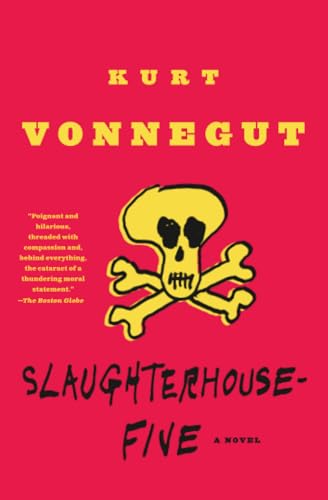
Slaughterhouse-Five
by Kurt Vonnegut
Kurt Vonnegut’s masterpiece, Slaughterhouse-Five is “a desperate, painfully honest attempt to confront the monstrous crimes of the twentieth century” (Time). Selected by the Modern Library as one of the 100 best novels of all time • One of The Atlantic’s Great American Novels of the Past 100 Years Slaughterhouse-Five, an American classic, is one of the world’s great antiwar books. Centering on the infamous World War II firebombing of Dresden, the novel is the result of what Kurt Vonnegut described as a twenty-three-year struggle to write a book about what he had witnessed as an American prisoner of war. It combines historical fiction, science fiction, autobiography, and satire in an account of the life of Billy Pilgrim, a barber’s son turned draftee turned optometrist turned alien abductee. As Vonnegut had, Billy experiences the destruction of Dresden as a POW. Unlike Vonnegut, he experiences time travel, or coming “unstuck in time.” An instant bestseller, Slaughterhouse-Five made Kurt Vonnegut a cult hero in American literature, a reputation that only strengthened over time, despite his being banned and censored by some libraries and schools for content and language. But it was precisely those elements of Vonnegut’s writing—the political edginess, the genre-bending inventiveness, the frank violence, the transgressive wit—that have inspired generations of readers not just to look differently at the world around them but to find the confidence to say something about it. Authors as wide-ranging as Norman Mailer, John Irving, Michael Crichton, Tim O’Brien, Margaret Atwood, Elizabeth Strout, David Sedaris, Jennifer Egan, and J. K. Rowling have all found inspiration in Vonnegut’s words. Jonathan Safran Foer has described Vonnegut as “the kind of writer who made people—young people especially—want to write.” George Saunders has declared Vonnegut to be “the great, urgent, passionate American writer of our century, who offers us . . . a model of the kind of compassionate thinking that might yet save us from ourselves.” More than fifty years after its initial publication at the height of the Vietnam War, Vonnegut’s portrayal of political disillusionment, PTSD, and postwar anxiety feels as relevant, darkly humorous, and profoundly affecting as ever, an enduring beacon through our own era’s uncertainties.

Book
Breakfast of Champions
by Kurt Vonnegut
“Marvelous . . . [Vonnegut] wheels out all the complaints about America and makes them seem fresh, funny, outrageous, hateful and lovable.”—The New York Times In Breakfast of Champions, one of Kurt Vonnegut’s most beloved characters, the aging writer Kilgore Trout, finds to his horror that a Midwest car dealer is taking his fiction as truth. What follows is murderously funny satire, as Vonnegut looks at war, sex, racism, success, politics, and pollution in America and reminds us how to see the truth. “Free-wheeling, wild and great . . . uniquely Vonnegut.”—Publishers Weekly

Book
The Sirens of Titan
by Kurt Vonnegut
“[Kurt Vonnegut’s] best book . . . He dares not only ask the ultimate question about the meaning of life, but to answer it.”—Esquire Nominated as one of America’s best-loved novels by PBS’s The Great American Read The Sirens of Titan is an outrageous romp through space, time, and morality. The richest, most depraved man on Earth, Malachi Constant, is offered a chance to take a space journey to distant worlds with a beautiful woman at his side. Of course there’ s a catch to the invitation–and a prophetic vision about the purpose of human life that only Vonnegut has the courage to tell. “Reading Vonnegut is addictive!”—Commonweal

Book
Timequake
by Kurt Vonnegut
A New York Times Notable Book from the acclaimed author of Slaughterhouse-Five, Breakfast of Champions, and Cat's Cradle. At 2:27pm on February 13th of the year 2001, the Universe suffered a crisis in self-confidence. Should it go on expanding indefinitely? What was the point? There's been a timequake. And everyone—even you—must live the decade between February 17, 1991 and February 17, 2001 over again. The trick is that we all have to do exactly the same things as we did the first time—minute by minute, hour by hour, year by year, betting on the wrong horse again, marrying the wrong person again. Why? You'll have to ask the old science fiction writer, Kilgore Trout. This was all his idea.